The Dragon Stairway
The park’s most recognisable image. The figure covered in trencadís stands on the monumental stairway: notice how colour accompanies the route.
THE PARK’S ICONGAUDÍ’S PARK IN BARCELONA
Discover Park Güell: its mosaics, its stone paths and the story of a garden city that became a place for everyone.
Before you leaveBook your ticket, choose your entrance and allow for the hills.
Official visitor informationLOOK BEYOND THE MOSAIC
The best way to understand the park is to walk through it: its architecture follows the terrain and connects the spaces intended for the residents of the development.
The park’s most recognisable image. The figure covered in trencadís stands on the monumental stairway: notice how colour accompanies the route.
THE PARK’S ICONA forest of 86 columns designed to house the market. Look up: the ceiling decoration includes the work of Josep Maria Jujol, Gaudí’s collaborator.
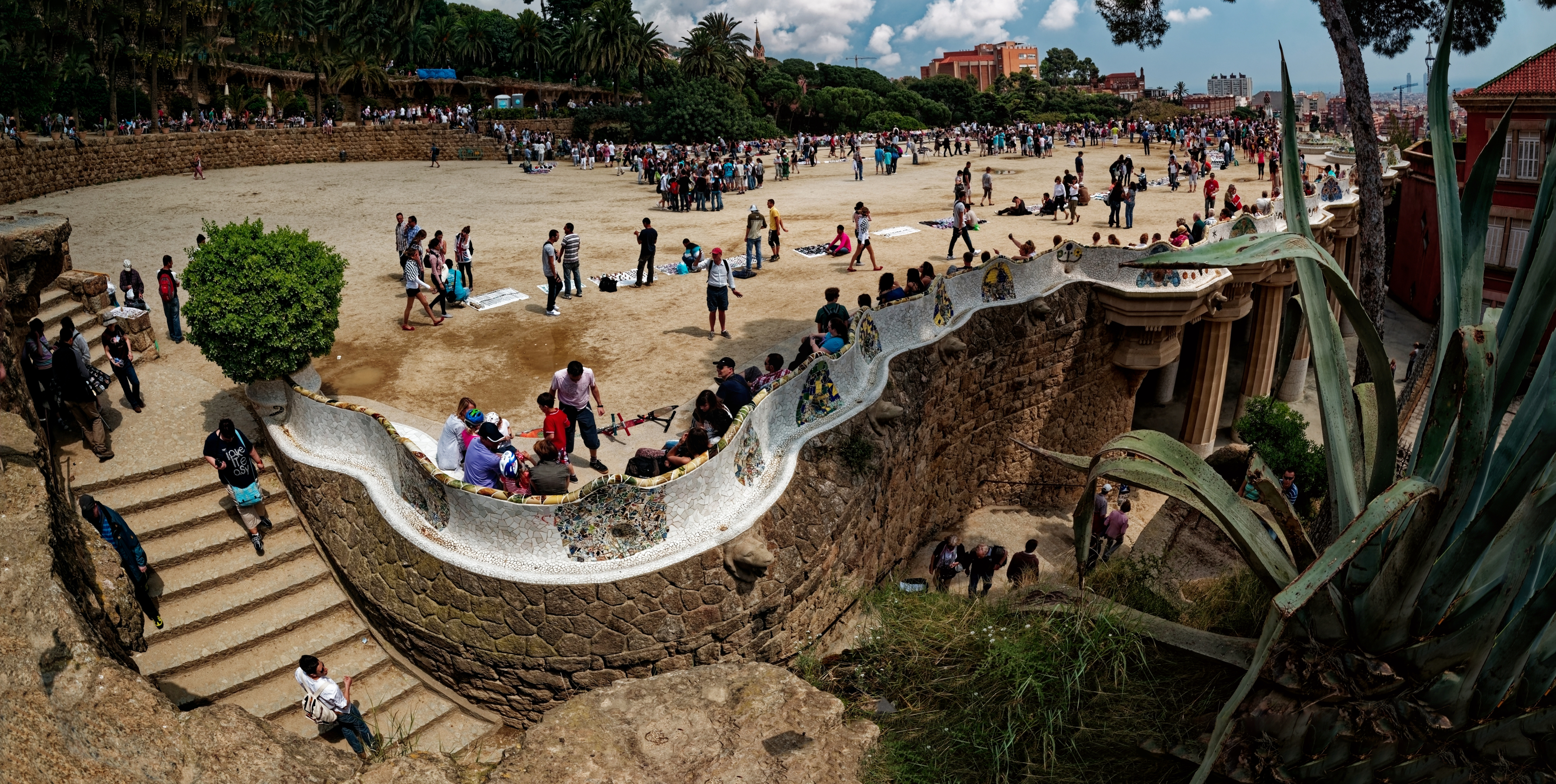
ARCHITECTURE AND DETAILThe broad terrace overlooking Barcelona, framed by the serpentine bench. Take a few minutes to look at the curves and the fragments of ceramic in the trencadís.
VIEWS OF THE CITYLeaning columns, elevated paths and stone that blends into the landscape. Walk through the Laundry Room Portico and discover a different side of the park, less colourful and more mineral.
A WALK THROUGH STONEFind out more: the park’s emblematic spaces · Hypostyle Room.
CHOOSE YOUR ROUTE
The park is on a hill. A distance on the map doesn’t tell you the whole climb: choose your entrance according to your transport and your needs.
Allow about 20 minutes on foot from the station. The recommended route follows Avinguda del Santuari de Sant Josep de la Muntanya. Leave time for the uphill walk and check for access disruptions.
From Travessera de Dalt, the walk to the park takes about 10 minutes. Continue along Carrer de Larrard or Avinguda del Santuari de Sant Josep de la Muntanya.
There is a taxi area on this road. The park’s management recommends this entrance for visitors with reduced mobility; check the accessible routes before you go.
Don’t rely on street parking: much of the surrounding area is reserved for residents. Use public transport where possible.
A LITTLE PLANNING, A BETTER WALK
Give yourself time to enjoy it. We suggest allowing between an hour and a half and two hours, adapting the route to your pace.
Official tickets and opening timesCheck the price and opening times for your date on the official website. This guide does not sell tickets.
Availability is limited. Check the date, time and conditions of your ticket before arranging the rest of your day.
There are slopes and uneven paths. Bring what you need for the weather and take breaks, especially when visiting with children.
Avoid climbing on sculptures, leaving litter or blocking paths for photographs. Outside the park, remember that the surrounding streets are a residential neighbourhood.
Some paths are easier to navigate than others. Check the official information and ask park staff for guidance.
TWO PEOPLE, ONE EXTRAORDINARY IDEA
THE ARCHITECT
At Park Güell, Gaudí worked with the shape of the hill rather than imposing a grid on it. The viaducts, drainage and shared spaces respond practically to the terrain while creating a distinctive artistic expression.
Trencadís, a mosaic made from fragments, covers curved surfaces. Stone, columns and ceramics offer three different ways to look at his architecture. Jujol also contributed to the decorative richness of the ensemble.
THE DEVELOPER AND PATRON
The businessman commissioned Gaudí to design a residential development inspired by British parks. Their relationship had already produced projects such as Palau Güell and the church at Colònia Güell.
More than an occasional client, Güell was a patron and friend. The park reveals that collaboration: a private residential ambition that eventually became part of Barcelona’s public life.
Read about the history of the park and the relationship between Gaudí and Güell on the official website.
THE ESSENTIAL ANSWERS
Opening times, prices and conditions can change. For your particular date, the park operator’s information takes precedence.
For a tourist visit, arrange a dated and timed ticket through the official website. Free access options exist for groups that meet specific conditions; check whether you qualify.
Don’t assume your park ticket includes the house. Check the ticket options and conditions for the Gaudí House Museum when planning your visit.
It can be if you adapt the length of your visit, avoid the hottest hours and take breaks. A simple game: look for curves, colours and natural shapes in the mosaics and columns.
One suggested walk connects the entrance pavilions, stairway, Hypostyle Room, square and viaducts. Change the order according to your entrance, staff guidance and mobility.
No. Parc Gaudí is an independent guide. Reservations, access conditions and operational information are provided by parkguell.barcelona.
TAKE YOUR TIME IN THE PARK